
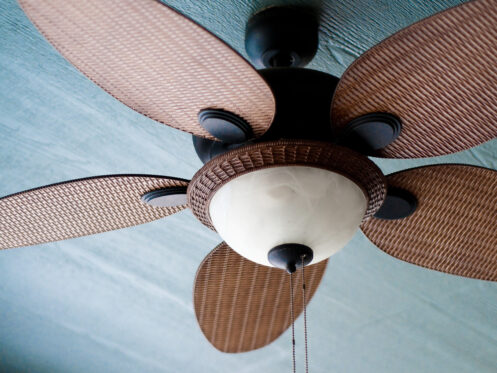
The scorching summer sun in Victorville, CA is no joke. Sometimes, no matter how much you crank up the AC, you still can’t get comfortable and your home feels like an oven. When stubborn heat lingers, making your home feel unbearably warm, you need a solution that cools without sending your energy bills skyrocketing.
Ceiling fans create comfortable and energy-efficient living spaces. When used correctly, they can significantly reduce energy consumption and improve your household’s comfort. If you’re looking for a more efficient home cooling solution that doesn’t cost a fortune to install, run or maintain, ceiling fans check all the boxes.
Understanding the Basics: How Ceiling Fans Work
A ceiling fan might seem like it’s cooling the air, but it’s actually creating a wind-chill effect. When the fan’s blades push air downwards, this creates a breeze. This breeze then evaporates moisture from your skin, which is what makes you feel cooler. This is also why many heating and air experts recommend turning ceiling fans off unless you’re in the room; the fan isn’t actually lowering the air temperature, only how you perceive it.
What’s Behind the Breeze: Wind Chill and Air Circulation
When set to push air downwards, ceiling fans create a consistent breeze. The breeze cools the skin by absorbing the perspiration the body naturally produces to regulate its temperature. Although your body absorbs heat and perspiration, a thin layer of humid air stays present around your skin.
This humid layer slows down the evaporation process, often stalling it. When you sit in a room with a ceiling fan, the evaporation process of the humid layer speeds up. The continuous movement of the fan aids in the more rapid removal of heat from your body and creates the wind-chill effect.
In addition to the wind-chill effect that ceiling fans produce, they also create more uniform temperatures in the room where they’re installed. Warm air rises, and when it mixes with the cooler air, it helps to destratify the air by mixing it at the surface.
Regular use of a ceiling fan will likely not change the setting on your thermostat. However, your perceived comfort level should improve significantly due to the wind-chill effect. What you might notice is that you can increase the temperature in your home without sacrificing comfort because the wind-chill effect makes you feel cooler. Many homeowners discover that using ceiling fans can result in substantial savings.
Tips for Optimal Ceiling Fan Use
Ceiling fans do more than cool. They can also make your home feel warmer during the winter months. Blade rotation is what allows the different functions that make you feel cooler or warmer. In the summer, ensure the ceiling blades rotate counterclockwise to push air down and produce a cooling effect.
Here are some other tips for getting the most out of your ceiling fans.
Choose the Correct Speed Settings
Choose the right speed for comfort without creating a draft that’s too strong. Do this by setting your fan to its lowest speed to create a gentle breeze. Give it a few minutes to gauge your comfort level. Larger rooms with higher ceilings might require a higher setting to circulate air effectively across the entire space. Conversely, smaller rooms with lower ceilings can accommodate lower settings.
Select the Optimal Installation Location
Center-room placement works well for most standard square or rectangular rooms. Center placement allows air to distribute evenly and create balanced airflow that reaches all corners. You want the ceiling fan installed eight to nine feet from the floor.
If you have high ceilings, your installer might use a downrod to ensure correct height placement. If you have the opposite problem (a shorter ceiling), your installer will likely use a flush-mount or “hugger” fan to attach the fan flush with the ceiling to provide adequate headroom while still offering some air circulation.
Choose the Right Size
Never take a one-size-fits-all approach to fan selection. Instead, choose the right size for your room. Here’s a quick guide our heating and cooling specialists refer to:
- Small rooms (up to 75 square feet): 29-36 inch fan
- Medium rooms (76-144 square feet): 36-42 inch fan
- Larger rooms (144-225 square feet): 44-inch fan
- Great rooms (225-400 square feet): 50-54 inch fan
Turn It Off When Not in Use
You may choose to turn off ceiling fans when no one is home to lower your home’s energy usage. There are exceptions to this rule, however. If you have pets, it’s worth keeping fans on during hot summer days to keep them safe and healthy. If your home has multiple stories or tall ceilings, you can also keep fans on to keep the temperatures in your home more evenly distributed. This can be especially useful if you choose to keep your fan on but turn off your air conditioning when you’re away.
Maintain the Fan
Ceiling fans don’t require a lot of maintenance, but you want to clean the blades periodically. You don’t want dust buildup to affect the fan’s performance. Also, if you notice the fan running wobbly, call a professional for troubleshooting and repairs to prevent further damage.
Beyond Cooling: Year-Round Benefits and Aesthetics
Ceiling fans do more than cool; they provide year-round benefits. In the winter, set the fan’s blades to rotate clockwise to distribute warm air from the ceiling. You’ll enjoy improved heat efficiency, as your body feels warmer, and you may be able to set the thermostat at a lower temperature.
Another benefit of ceiling fans is their ability to enhance a room’s aesthetic. Many people purchase ceiling fans with lights and use them to provide more uniform light in their rooms.
Rooms that feel stuffy or have poor air circulation often benefit from the ventilation that ceiling fans offer. Improving air circulation breaks up stagnant air, leading to improved circulation, reduced humidity and a fresher feeling in the room. Ceiling fans can help to prevent the smells that are partially due to stale air.
When to Call for Professional Help for Your Cooling Needs
You’ve decided a fan (or two or three) is exactly what your house needs. The next step is to call for professional ceiling fan installation in Victorville. Installing a ceiling fan isn’t a do-it-yourself job, even if you’re switching out a fan or have a ceiling fan rough-in.
Ceiling fan installation requires precise electrical skills. The installation process also includes balancing the fan to prevent it from becoming unstable and causing damage to the ceiling or separating during operation. You should also call for professional help if you notice that your fan no longer cools as well as it used to or makes unusual sounds. Professionals can quickly troubleshoot the issue and provide you with effective solutions.
Ceiling fans can enhance your comfort and contribute to energy savings for your cooling system. Learn more about our HVAC services and maintenance plans in Victorville and call Aace's Heating, Air Conditioning & Swamp Coolers today!